Here you can find free stuff Like Antiviruses, Free Web-Hosting Plans, Free Games and many more.

Get Updates on Internet of Things

Here You can Find Latest News and Reviews on Technology and the growing internet of things.

Get Paid Softwares and Games for free.

Here You can Find Piad Softwares for free and many others like Antiviruses,Anti-Malware,Photo-Editing,Games etc.

Find Your Desired Online Course for your Better Future.

Here You can Find Your Desired Carrer Making Free and Paid Online Courses and make your own Career.

Get Extra Deal Software

You can Find Extra Deal Softwares that including Parental Control, Firewalls and many more.

Get Best Development Softwares for Free.

If you are a Developer you Can Find Very Useful IDE's for your Work and that all are Free.

Showing posts with label scam. Show all posts

Friday, 7 July 2017

AlphaBay Dark Web Market Goes Down; Users Fear Exit-Scam
AlphaBay Dark Web Market Goes Down; Users Fear Exit-Scam 
Image result for AlphaBay Dark Web Market Goes Down; Users Fear Exit-Scam W AlphaBay Dark Web Market Goes Down; Users Fear Exit-Scam

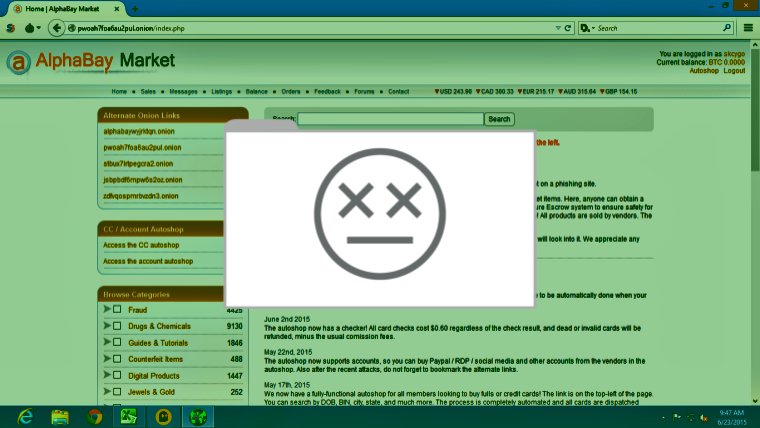
AlphaBay Market, one of the largest Dark Web marketplaces for drugs, guns, and other illegal goods, suddenly disappeared overnight without any explanation from its admins, leaving its customers who have paid large sums in panic.

AlphaBay, also known as "the new Silk Road," has been shut down since Tuesday night. The site also came in the news at the beginning of this year when a hacker successfully hacked the AlphaBay site and stole over 200,000 private unencrypted messages from several users.

Although the website sometimes goes down for maintenance, customers are speculating that the admins have stolen all their Bitcoins for good measure, when heard no words from the site's admins on the downtime.

Some users at Reddit and Twitter are claiming that AlphaBay's admins may have shut down the marketplace to withdraw a huge number of bitcoins from the site's accounts.

The withdrawal Bitcoin transactions total 1,479.03904709 Bitcoin (roughly $3.8 Million), which led to suspicion from some users that the site’s admins may have pulled an exit scam to steal user funds.

In March 2015, the largest (at the time) dark web market 'Evolution' suddenly disappeared overnight from the Internet, stealing millions of dollars worth of Bitcoins from its customers.

However, users no need to worry—at least right now when nothing is confirmed, and the timing of the two incidents—site downtime and Bitcoin withdrawals—may be just coincidental.

This is not the first time AlphaBay goes offline. Last year, the site went down for about four days. Also, the blockchain transactions of about $3.8 Million are not enough for AlphaBay moderators to go offline.

One user on Reddit calls for calm and patience, saying "Now I'll admit I don't know for sure what's going on, and I am a bit nervous myself because if this is the end then I've lost a couple of hundred dollars myself But think about it Last year alphabay went down for about 4 days."

"Everyone was saying for sure that this was it, but it was not. It took the alphabay moderators days to update people on what was going on too; they're known to do this. Also about that blockchain transaction.. 44 bitcoins rounds off to about 4 million US. [I don’t know] about you but that doesn't sound like nearly enough money."

While AlphaBay continues to be down, and AlphaBay-associated Redditor who goes by moniker Big_Muscles has called users to calm down, saying the site's servers are under update and will be "back online soon."

Also unlike Silk Road, there is no indication that the law enforcement took down the AlphaBay marketplace.

Silk Road was shut down in 2013 after the arrest of its unassuming founder, Ross William Ulbricht. The FBI seized bitcoins (worth about $33.6 million, at the time) from the site, which were later sold in a series of auctions by the United States Marshals Service (USMS).
AlphaBay Market, one of the largest Dark Web marketplaces for drugs, guns, and other illegal goods, suddenly disappeared overnight without any explanation from its admins, leaving its customers who have paid large sums in panic. AlphaBay, also known as "the new Silk Road," has been shut down since Tuesday night. The site also came in the news at the beginning of this year when a hacker successfully hacked the AlphaBay site and stole over 200,000 private unencrypted messages from several users. Although the website sometimes goes down for maintenance, customers are speculating that the admins have stolen all their Bitcoins for good measure, when heard no words from the site's admins on the downtime. Some users at Reddit and Twitter are claiming that AlphaBay's admins may have shut down the marketplace to withdraw a huge number of bitcoins from the site's accounts. The withdrawal Bitcoin transactions total 1,479.03904709 Bitcoin (roughly $3.8 Million), which led to suspicion from some users that the site’s admins may have pulled an exit scam to steal user funds. In March 2015, the largest (at the time) dark web market 'Evolution' suddenly disappeared overnight from the Internet, stealing millions of dollars worth of Bitcoins from its customers. However, users no need to worry—at least right now when nothing is confirmed, and the timing of the two incidents—site downtime and Bitcoin withdrawals—may be just coincidental. This is not the first time AlphaBay goes offline. Last year, the site went down for about four days. Also, the blockchain transactions of about $3.8 Million are not enough for AlphaBay moderators to go offline. One user on Reddit calls for calm and patience, saying "Now I'll admit I don't know for sure what's going on, and I am a bit nervous myself because if this is the end then I've lost a couple of hundred dollars myself But think about it Last year alphabay went down for about 4 days." "Everyone was saying for sure that this was it, but it was not. It took the alphabay moderators days to update people on what was going on too; they're known to do this. Also about that blockchain transaction.. 44 bitcoins rounds off to about 4 million US. [I don’t know] about you but that doesn't sound like nearly enough money." While AlphaBay continues to be down, and AlphaBay-associated Redditor who goes by moniker Big_Muscles has called users to calm down, saying the site's servers are under update and will be "back online soon." Also unlike Silk Road, there is no indication that the law enforcement took down the AlphaBay marketplace. Silk Road was shut down in 2013 after the arrest of its unassuming founder, Ross William Ulbricht. The FBI seized bitcoins (worth about $33.6 million, at the time) from the site, which were later sold in a series of auctions by the United States Marshals Service (USMS).
Share:

Wednesday, 21 June 2017

WebSites Found Collecting Data from Online Forms Evena Before You Click Submit

WebSites Found Collecting Data from Online Forms Evena Before You Click Submit
Image result for WebSites Found Collecting Data from Online Forms Even Before You Click Submit
'Do I really need to give this website so much about me?'

That's exactly what I usually think after filling but before submitting a web form online asking for my personal details to continue.

I am sure most of you would either close the whole tab or would edit already typed details (or filled up by browser's auto-fill feature) before clicking 'Submit' — Isn't it?

But closing the tab or editing your information hardly makes any difference because as soon as you have typed or auto-filled anything into the online form, the website captures it automatically in the background using JavaScript, even if you haven't clicked the Submit button.
During an investigation, Gizmodo has discovered that code from NaviStone used by hundreds of websites, invisibly grabs each piece of information as you fill it out in a web form before you could hit 'Send' or 'Submit.'

NaviStone is an Ohio-based startup that advertises itself as a service to unmask anonymous website visitors and find out their home addresses.

There are at least 100 websites that are using NaviStone's code, according to BuiltWith, a service that tells you what tech sites employ.

Gizmodo tested dozens of those websites and found that majority of sites captured visitors' email addresses only, but some websites also captured their personal information, like home addresses and other typed or auto-filled information.

How Websites Collect 'Data' Before Submitting Web Forms

websites-collect-data
Using JavaScript, the websites in question were sending user's typed or auto-filled information of an online form to a server at "murdoog.com," which is owned by NaviStone, leaving no option for people who immediately change their minds and close the page.

When the publication asked NaviStone that how it unmasks anonymous website visitors, the company denied revealing anything, saying that "its technology is proprietary and awaiting a patent."

However, when asked whether email addresses are gathered in order to identify the person and their home addresses, the company's chief operating officer Allen Abbott said NaviStone does not "use email addresses in any way to link with postal addresses or any other form of PII [Personal Identifiable Information]."
"Rather than use email addresses to generate advertising communications, we actually use the presence of an email address as a suppression factor, since it indicates that email, and not direct mail, is their preferred method of receiving advertising messages," Abbott said.
Some websites using NaviStone's code are collecting information on visitors who are not even their customers and do not share any relationship with the companies.

"Three sites—hardware site Rockler.com, gift site CollectionsEtc.com, and clothing site BostonProper.com—sent us emails about items we'd left in our shopping carts using the email addresses we'd typed onto the site but had not formally submitted," Gizmodo writes.

After the story had gone live, NaviStone agreed to no longer collect email addresses from visitors this way, as Abbott said, "While we believe our technology has been appropriately used, we have decided to change the system operation such that email addresses are not captured until the visitor hits the 'submit' button."

Disable Auto-Fill; It’s Leaking Your Information!


In order to protect yourself from such websites collecting your data without your consent, you should consider disabling auto-fill form feature, which is turned on by default, in your browser, password manager or extension settings.

At the beginning this year, we also warned you about the Auto-fill feature, which automatically fills out web form based on data you have previously entered in similar fields but can be misused by attackers hiding fields (out of sight) in the web form and stealing your personal information without your knowledge.

Here's how to turn this feature off in Chrome:

Go to Settings → Show Advanced Settings at the bottom, and under the Passwords and Forms section uncheck Enable Autofill box to fill out web forms with a single click.

In Opera, go to Settings → Autofill and turn it off.

In Safari, go to Preferences and click on AutoFill to turn it off.

Also, think twice before filling your details into any web form, before it gets too late.

Share:

Saturday, 3 June 2017

Here's the Facebook Hacking Tool that Can Really Hack Accounts, But

Here's the Facebook Hacking Tool that Can Really Hack Accounts, But...
Image result for Here's the Facebook Hacking Tool that Can Really Hack Accounts, But

Yes, you heard me right.

A newly discovered Facebook hacking tool actually has the capability to hack Facebook account, but YOURS, and not the one you desire to hack.

How to Hack Facebook account? How to Hack my Girlfriends Facebook account? My boyfriend is cheating on me, How do I hack his Facebook Account?
These are the queries that most of the Internet users search on Google.

But Beware! If you come across any Facebook hacking tool that promises you to help you hack your friends Facebook accounts, you may end up downloading a hacking tool that could hack you, instead of them.

Facebook  Hacking Tool that Can Really Hack, But Your Accounts

Facebook Hacking Tool
Dubbed Remtasu, the tool is marketing itself as a Facebook hacking tool but actually is a Windows-based Trojan that has accelerated globally over the past year, and has now capability to disguise itself as an app for accessing people's Facebook account credentials.

The tool contains a Keylogger that can capture all your keystrokes and store them in a file that is subsequently sent to the attacker's server.

The malicious Facebook hacking tool is exploiting "the constant desire of a lot of users to take control of accounts from this well-known social network," according to a Monday blog post by IT security company ESET.

How Remtasu Works:


The malicious tool is delivered via direct download websites.
Once a user visits one of these websites, the dangerous Win32/Remtasu.Y malware automatically gets downloaded and executed on victim's machine and hide itself among other files.

Remtasu has capability to:
  • Open and obtain information from the clipboard.
  • Capture keystrokes.
  • Store all the data in a file which is subsequently sent to an FTP server.

    The worst part is yet to come:


    The malware remains on the infected computer even when the victim reboots their system or attempts to find the malware threat in the list of active processes.

    "In this case, the malware replicates itself, saving the copy in a folder that it also creates within the system32 folder," reads the post. "The new InstallDir folder remains hidden inside the system files, making it difficult for users to access."

    Most affected parts of the world include Colombia, Turkey, Thailand and elsewhere. In past, Remtasu was distributed through malicious files attached to phishing emails purporting to be from legitimate government or businesses organisations.
    Share:

    Sunday, 28 May 2017

    All Android Phones Vulnerable to Extremely Dangerous Full Device Takeover Attack

    All Android Phones Vulnerable to Extremely Dangerous Full Device Takeover Attack

    Image result for All Android Phones Vulnerable to Extremely Dangerous Full Device Takeover Attack

    Researchers have discovered a new attack, dubbed 'Cloak and Dagger', that works against all versions of Android, up to version 7.1.2.

    Cloak and Dagger attack allows hackers to silently take full control of your device and steal private data, including keystrokes, chats, device PIN, online account passwords, OTP passcode, and contacts.

    What's interesting about Cloak and Dagger attack?

    The attack doesn't exploit any vulnerability in Android ecosystem; instead, it abuses a pair of legitimate app permissions that is being widely used in popular applications to access certain features on an Android device.

    Researchers at Georgia Institute of Technology have discovered this attack, who successfully performed it on 20 people and none of them were able to detect any malicious activity.

    Cloak and Dagger attacks utilise two basic Android permissions:

    • SYSTEM_ALERT_WINDOW ("draw on top")
    • BIND_ACCESSIBILITY_SERVICE ("a11y")

    The first permission, known as "draw on top," is a legitimate overlay feature that allows apps to overlap on a device's screen and top of other apps.
    The second permission, known as "a11y," is designed to help disabled, blind and visually impaired users, allowing them to enter inputs using voice commands, or listen content using screen reader feature.

    Scary Things Hackers Can Do to Your Android (Demo)


    Since the attack does not require any malicious code to perform the trojanized tasks, it becomes easier for hackers to develop and submit a malicious app to Google Play Store without detection.

    Unfortunately, it’s a known fact that the security mechanisms used by Google are not enough to keep all malware out of its app market.

    If you are following regular security updates from The Hacker News, you must be better aware of frequent headlines like, "hundreds of apps infected with adware targeting play store users," and "ransomware apps found on play store."

    Just last month, researchers uncovered several Android apps masqueraded as an innocent "Funny Videos" app on Play Store with over 5,000 downloads but distributed the 'BankBot banking Trojan' that steal victims' banking passwords.

    Here's what the researchers explained how they got on the Google Play Store to perform Cloak & Dagger attacks:
    "In particular, we submitted an app requiring these two permissions and containing a non-obfuscated functionality to download and execute arbitrary code (attempting to simulate a clearly malicious behavior): this app got approved after just a few hours (and it is still available on the Google Play Store)." researchers say.
    Once installed, the researchers say the attacker can perform various malicious activities including:

    • Advanced clickjacking attack
    • Unconstrained keystroke recording
    • Stealthy phishing attack
    • Silent installation of a God-mode app (with all permissions enabled)
    • Silent phone unlocking and arbitrary actions (while keeping the screen off)

    In short, the attackers can secretly take over your Android device and spy on your every activity you do on your phone.

    Google Can’t Fix It, At Least Not So Fast


    University researchers have already disclosed this new attack vector to Google but noted that since the issue resides in the way Android OS has been designed, involving two of its standard features that behave as intended, the problem could be difficult to resolve.
    "Changing a feature is not like fixing a bug," said Yanick Fratantonio, the paper's first author. "System designers will now have to think more about how seemingly unrelated features could interact. Features do not operate separately on the device."
    As we reported earlier, Google gives "SYSTEM_ALERT_WINDOW" ("draw on top") permission to all applications directly installed from the official Google Play Store since Android Marshmallow (version 6), launched in October 2015.

    This feature that lets malicious apps hijack a device's screen is one of the most widely exploited methods used by cyber criminals and hackers to trick unwitting Android users into falling victims for malware and phishing scams.

    However, Google has planned to change its policy in 'Android O,' which is scheduled for release in the 3rd quarter this year.

    So, users need to wait for a long, long time, as millions of users are still waiting for Android Nougat (N) from their device manufacturers (OEMs).

    In other words, the majority of smartphone users will continue to be victimised by ransomware, adware and banking Trojans at least for next one year.

    Temporary Mitigation


    The easiest way to disable the Cloak and Dagger attacks in Android 7.1.2 is to turn off the "draw on top" permission by heading on to:

    Settings → Apps → Gear symbol → Special access → Draw over other apps.

    The universal and easiest way to avoid being hacked is always to download apps from Google Play Store, but only from trusted and verified developers.

    You are also advised to check app permissions before installing apps. If any app is asking more than what it is meant for, just do not install it.
    Share:

    3 Nigerian Scammers Get 235-Years of Total Jail Sentence in U.S.

    3 Nigerian Scammers Get 235-Years of Total Jail Sentence in U.S.

    Image result for 3 Nigerian Scammers Get 235-Years of Total Jail Sentence in U.S.

    You may have heard of hilarious Nigerian scams. My all time favourite is this one:

    A Nigerian astronaut has been trapped in space for the past 25 years and needs $3 million to get back to Earth, Can you help?

    Moreover, Nigerians are also good at promising true love and happiness.

    But You know, Love hurts.

    Those looking for true love and happiness lost tens of millions of dollars over the Nigerian dating and romance scams.
    These criminals spend their whole day trolling the online dating sites for contact emails and then send off hundreds of thousands of fraudulent emails awaiting the victim's response.

    A US federal district court in Mississippi has sentenced such three Nigerian scammers to a collective 235 years in prison for their roles in a large-scale international fraud network that duped people out of tens of millions of dollars.

    The three Nigerian nationals were part of a 21-member gang of cyber criminals, of which six, including Ayelotan, Raheem, and Mewase, were extradited from South Africa to the Southern District of Mississippi in July 2015 to face charges in the case.

    • Oladimeji Seun Ayelotan, 30, faces up to 95 years in prison
    • Rasaq Aderoju Raheem, 31, faces up to 115 years in prison
    • Femi Alexander Mewase, 45, faces up to 25 years in prison

    A federal jury found all of them guilty of offenses involving mail fraud, wire fraud, credit card fraud, identity theft, and theft of government property, the US Department of Justice announced Thursday.

    Also, Ayelotan and Raheem were found guilty of conspiracies to commit bank fraud and money laundering, which is why they have been given longer prison sentences.
    Until now, the justice department has charged a total of 21 suspects in this case: 12 defendants have already pleaded guilty to charges related to the conspiracy while 11 have been sentenced to date.

    The gang has been operating since 2001 and ran a variety of online scams, including romance scams, where the criminals used the false identity of love-struck girlfriends on a dating site to establish a romantic relationship with unsuspecting victims.

    Once the gang members gained the victim's trust and affection, they would convince them to carry out their money laundering schemes and launder money from other rackets via MoneyGrams and Western Union, or resend electronics and other goods bought with stolen credit cards to countries where they could be sold for a profit.

    The gang members were arrested by South African police in a joint operation with U.S. Immigration and Customs Enforcement's Homeland Security Investigations (HSI) and the U.S. Postal Inspection Service in December 2015.

    However, Nigerian scams will never die, and you could be their next victim.
    Share:

    Contact

    Dr. Cyborg Inc.

    Home City: Okara , Pakistan

    Email: usama.asif.shah08@gmail.com

    Support

    Need Your help to Improve my Website and also you can Share your Ideas of customize this Website? Contact me what you think about my Website.

    Viewers